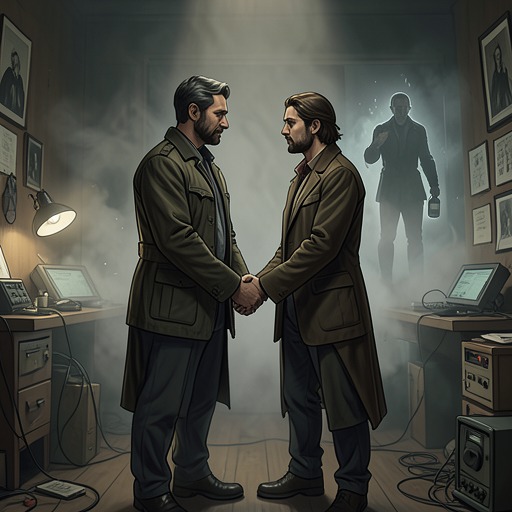
Nic and Z. face a drug crisis in Oakland
Beautiful Boy: A Father's Journey Through His Son's AddictionNic and Z.’s crisis in Oakland turns on a contradiction: Nic asks people who love him for help while concealing where he is and what has happened. After claiming that he and Z. are in the desert near Joshua Tree, he reveals to his godfather and Vicki that they are in danger at an Oakland home; his later messages revive the desert story even after he knows the truth has reached his father. The episode makes escape, honesty, and the limits of family intervention inseparable.
From the desert story to Oakland
Two days before the crisis becomes clear, Nic calls slurring and asks for rent money. He delays the request until after telling his father that he loves him, is safe, and that they will be fine. He then admits to taking something to come down from meth, coke, and heroin. His father refuses the money, and Vicki does too. The exchange establishes both the immediate drug context and the boundary the parents are trying to hold: affection does not mean unrestricted financial help. After a silent weekend, an email arrives on Monday in Nic’s familiar, casual voice. He says that he and Z. are in the desert near Joshua Tree, where Z. is doing a commercial. His phone has no reception, he says, and he has borrowed a computer briefly from someone on the set. He describes the heat and boredom, says he is writing in the shade, tells his father not to fret, and hints at exciting news. The details make the account feel ordinary and plausible. His father takes it as a possible respite, imagining that Nic might stop using on his own and be all right.
The appeal for help
The desert account breaks when Nic’s godfather calls to say that Nic has left him an alarmed message: he is in Oakland, in trouble, and needs help. Vicki has received a similar appeal. Nic tells her, “I'm sober. Please, we're in trouble. We need plane tickets back to LA.” His explanation of how he and Z. got there is convoluted, but the urgent fact is straightforward: they are staying at the home of a crack addict whom Nic describes as out of his mind, and they need to get away. Nic’s call to his godfather gives the request a second, more distressed form. The godfather plays the answering-machine message to Nic’s father over the phone; Nic’s slurred voice says, “I need help. I can't call my dad. I don't know what to do, please give me a call.” He leaves Z.’s cell-phone number. The message brings Nic’s danger close, but it also leaves the adults to decide what kind of help might actually get him out. His godfather admits that part of him wants to drive to Oakland to retrieve Nic and part of him wants to wring his neck, a blunt expression of the care and anger occupying the same response. Vicki is unsure whether she should buy plane tickets. Nic’s father understands the hesitation and advises against paying unless Nic is willing to enter rehabilitation; in that case, he says, he might help. The condition distinguishes assistance toward treatment from a rescue that simply removes Nic from the immediate danger. Meanwhile, the father imagines what Nic might do if he comes to the family home while high, recalling an earlier occasion when Nancy found him in a downstairs bedroom. He and Karen consider warning Karen’s parents in case Nic appears there. Their decision to call shows that the Oakland emergency revives fears of an earlier intrusion, extending the crisis beyond the place where Nic and Z. are staying.
A lie revised and repeated
The next day, Nic leaves messages for his godfather and Vicki with a new account: the crack addict’s girlfriend has appeared and given Nic and Z. money to fly home. Later, Nic’s girlfriend’s phone appears on the father’s screen while he is working at the Corte Madera library. He initially refuses to listen, having no desire to hear more lies, but listens while driving to pick up the children. Nic now says that he and Z. are driving back from Joshua Tree and have finally reached cell-phone range. The father is struck by the elaborateness of the deception. Nic could have said only that he was back in Los Angeles, or called without explaining further; instead, he extends the original desert account with a return journey and an explanation for the earlier silence. The falsehood’s detail is what makes it persuasive, and also what exposes the work required to sustain it. The father listens several times because he wants to remember the message. He wonders whether Nic has forgotten that he told his mother and godfather he was in serious danger in Oakland, and whether he assumes that those who care about him will not compare what they have heard.
Exposure without resolution
In the Joshua Tree message, Nic sounds fine rather than slurred and says that he misses and loves his father. A later call makes clear that he now knows his father has learned the truth. Nic says, “I just found out that you know the truth of what happened.” He explains that he did not want his father to worry, did not want to be pressured to visit while in the Bay Area, and had not known that the man at the Oakland home would turn out to be dangerous. He says that he and Z. got out as best they could and apologizes for lying. The explanation acknowledges the deception, but comes after several incompatible accounts and does not erase the earlier appeal for help. The episode moves from Nic’s request for money, to an apparently reassuring email, to urgent calls from Oakland, and back to an elaborate claim that he is still returning from Joshua Tree. Its narrative sequence makes the father’s knowledge arrive through other people before Nic can control what he tells him. After the apology, the father notices a pile of newspapers: an SF Weekly, a Bay Guardian, and a flyer from Amoeba Records, Nic’s favorite store. Karen says the papers are not hers. The scene supplies a concrete trace without explaining it further, leaving the immediate situation unsettled. Oakland marks not a clean escape from danger, but another turn in the family’s struggle to distinguish rescue from treatment and reassurance from truth.